Dynabrade trykkluftdrevet støvsuger - modell med ATEX godkjenning for veggmontering
The Dynabrade 61471 Dynabrade Raptor Vac Pneumatic Portable Vacuum
System Model 61471 ATEX Zone 21, Wall-Mount Style aggressively
captures workplace dust and debris to provide a productive and safe
working environment. Dynabrade Portable Vacuum Systems are designed to
adhere to the new and exacting standards of EU Working Dust Regulations.
Raptor vacuums are certificated for EU standards including M-class, ATEX, EX (explosive proof) Zone 21 and Zone 22.
Production rates will also greatly improve, as any dust particles
caught between the tool and the work surface will be extracted, allowing
the grit of the abrasive to cut into the work quicker and more
precisely. Dynabrade raptors can be powered electrically and
pneumatically, the latter being ideal for carbon fibre dust. Conductive
and non-conductive hoses can be used to discharge any static charge
back to earth.
Combustible dust could be
ignited if there was a spark, open flame (even from a cigarette),
radiation, heat, static or a lightning strike. This could cause an
explosion or a fire. While some of these causes may seem unlikely, you
must assess the risk in normal operating conditions. Where there is any
risk, you will need a metal dust extraction system to contain the dust
and render it inert.
Understanding ATEX Directives
 The
European Union has published two directives about dealing with an
‘explosive atmosphere’, known as ATEX Directives. The directives define
different environments as zones, according to the size of the space, its
characteristics, and the likelihood of an explosion. It is a rough
equivalent to the HAZLOC system used in the USA.
Metal dust
extraction equipment is marked with a category number, plus the letter
‘D’ for dust. There are three different zone definitions that you’ll
need to be aware of when looking for the right category of ATEX
certified metal dust extraction equipment:
- Zone 20 describes a very high risk of explosion from a cloud of dust, where the risk is continuous or long-term; you will need Category 1 equipment
- Zone 21 describes an area where dust is likely to create an explosive mixture occasionally; you will require Category 2 equipment
- Zone 22 describes an area where an explosive mixture is unlikely, or would only exist for a short time; for this zone, you will require Category 3 equipment
There
are some situations where Category 1 equipment can be used in Zone 21,
and where Category 1 or 2 equipment can be used in Zone 22. Consult the
Health and Safety Executive for guidance on your specific circumstances.
Understanding Atmosphere Ratings
Different
metal dust extraction machines are designed for different substances,
with three specific Groups relating to dust extraction. It’s important
to check that the machine you want to buy is rated for the type of dust
you are working with:
- Group E: Combustible metal dust
- Group F: Combustible dusts from carbon-based materials such as coal and charcoal
- Group G: Wood, plastic and other combustible dusts not covered in category E or F
Many
machines cover more than one Group; some are suitable for general
usage. Check the product description carefully, and consult the
manufacturer’s manual for guidance on each Group.
How Metal Dust Extraction Machines Work
Metal
dust extractors contain and remove dust using a vacuum and a tank. The
tank contains liquid to contain the collected dust. Depending on the
machine, the liquid will normally be water, paraffin oil or mineral oil.
A
metal dust extraction machine can hold between 2kg and 10kg of dust in
up to 30 litres of liquid. The tank on most machines is detachable for
simple disposal; some units have a disposable or reinforced bag,
although this is optional.
Machines can be electric, or pneumatic.
Pneumatic machines are advisable for hazardous environments where
sparks may ignite airborne dust. Additionally, when choosing a metal
dust extraction machine, make sure you choose the correct type of
capture: dry or wet. Dry is for use with ordinary sanders and grinders,
while wet capture equipment is for tools with a water feed. For general
purpose, you can purchase machines that dispose of both wet and dry
dust.
Some dry metal dust extraction machines have a coalescing
filter element (CFE) fitted. These filter elements remove moisture from
the captured material.
Metal Dust Extraction Machine Features
At
DynaShop the complete range of Dynabrade “Raptor Vac” Portable Vacuum
Systems. These portable machines are certified as Category 2 and/or
Category 3 machines. Some machines are legally certified in their
ability to dissipate static electricity, and have a conductive case for
safety; others are non-conductive for general purpose use. All units are
leak tested with aerosols.
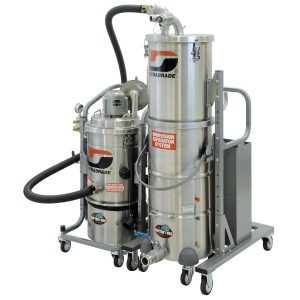
For flexibility, portable vacuums
allow you to tow the equipment around and stow tools alongside the
machine, or on the shelf on top. Some machines allow the connection of
two tools simultaneously; ideal if you are working in a small space.
While these machines vary considerably in size, the cart allows them to
be moved freely. Carts can be purchased separately if required.
Manufacturers
also offer ‘backpack style’ portable vacuums that are worn on the body
for convenience, as well as machines that can be mounted on a wall or
another cart. These machines are smaller and lighter than the models on
wheels, and can be used with a bag for simple disposal.
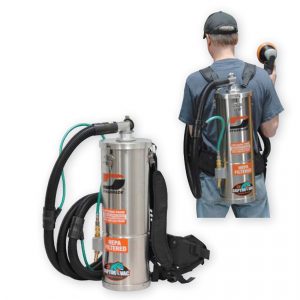 Metal Dust Extraction: Backpack Style
A
HEPA filter will prevent the redistribution of fine dust into the
working environment. Some metal dust extraction machines offer automatic
HEPA filter cleaning, using clean air to blast the filter at frequent
intervals. For this Bypass Motor System feature to work, the machine
must be connected to an external air hose.